Bully at Work Moody Boss Karma Office Gossip No Picnic Back stabber Plug your Ears Moody Boss

Job Hunt: Equal or Better Your Last Salary

Photo of man on stool ©istockphoto.com /RichVintage

Due to the current economic conditions, companies are looking for the most profit-oriented leaders they can find.

BY JOHN A. CHALLENGER

They also aim to attract executives and managers who have a record from past assignments that defines them as successful motivators. For many in this job market, simply finding and holding on to a job takes priority over the compensation level. The key to staying on the payroll once you are able to find a job involves demonstrating to an employer that you are able to do many things during a period when many companies remain heavily focused on cost containment. You should not only do the job that you were hired to do, but you should augment it with additional work whenever possible. It may require more hours on the job and some advance planning during non-work hours, but the dividends can be significant. More…

Distant corner office vs Cube next to Boss?

Text and line illustration by Franke James, MFA.; Businessmen working in a green field ©istockphoto.com/René Mansi, Urban Cow

Dear Office-Politics,

We are doubling the size of our current office space due to rapid growth. At the current office where I am one of several managers, I have a corner office right next to my boss. My boss is taking the choice office at the far end of the new office space and if I move to stay close to him, I will have to give up the corner office and move into a smaller space. If I stay in my current office, I will be at the far end of the office from him. From an organizational perception standpoint, how important is it for me to be close to the seat of power? If I do not lose will I be viewed as less important? Out of the loop? Out of sight out of mind?

Take Advantage of the Time Between Jobs

Photo of TV watcher outside ©istockphoto.com /urbancow

The latest Challenger report of quarterly job search times indicates that during the last quarter of 2008, it took job seekers about 3.0 months to find a new position. It is an ample amount of time to conduct professional self-improvement.

By taking a proactive stance to increase marketable skills, a candidate will increase opportunities for securing a satisfying position. From taking a computer language course at a local community college to starting an MBA program online at a high-profile university, job seekers will increase their marketability simply by being enrolled.

Improving your ability to get hired, especially in an economy such as this one, is tantamount to landing the next job offer. Human resource executives notice which candidates have taken it upon themselves to update their skills through education. Companies want employees who have the zeal to be life-long learners.

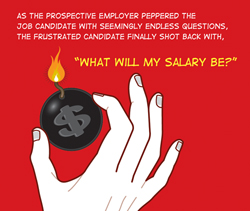
The Job Hunt: Forget the money; Get the offer

Dialogue Script Text by Franke james; Illustrated hand economy troubles ©istockphoto.com /sammyc

Inquiring about salary and benefits early in the interview process is a cardinal mistake for a job seeker. It is one of the primary reasons prospective jobs are lost prematurely. It sends a negative signal to the employer that you are more interested in yourself than in the company and focuses attention away from your capabilities and accomplishments, where the spotlight belongs. We usually advise job seekers to say nothing about money, if possible, until after the employer makes a job offer. The subject of salary and benefits will obviously come up at some time during the interview process. Once the company decides it likes you and wants to make an offer, it certainly will tend to be higher than if you insist on knowing about compensation before the company realizes how good you are. One of the surest ways to sabotage your chances is to start discussing your monetary needs before the potential employer has a chance to get acquainted with you.

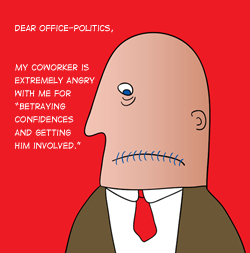
Leading by example, straight off a cliff…

Headline by Franke James, MFA.; Man with stitched mouth illustration ©istockphoto.com/MirekP

Dear Office-Politics,

I am second in command (transitioning soon to first in command) of a tight-knit team that excels at our jobs. We focus on collaboration and high-quality output, and communication is essential. I am generally known as an individual that will accept nothing less than excellence, and most of the team members appreciate that. However, one junior level member recently completed a project at home (out of sight) and went to another office for review, specifically asking the other person to not mention that he had talked with them. That person, recognizing the potential for catastrophe, told me immediately, but asked me to keep it confidential.

I am relatively new at a leadership role, and so the first thing I did was talk to my immediate supervisor to ask for his opinion. I outlined the situation as I have told it here, including the sub-par project for review and expressed to my supervisor that the other office person did not want to be involved.

A Twisted Tornado of Office Politics

Tornado by Franke James, MFA.; Men in field with paper ©istockphoto.com/ urbancow

Dear Office-Politics,

I was recently involved in a TWISTED TORNADO of office politics.

At the time, I had no clue I was actually in the “clique”. I got close to a fellow employee who knew everyone… talked to everyone and talked about EVERYONE! She was promoted (although unqualified) because of her “personal” relationships with upper management. I work for a HUGE Corp. and this is completely unacceptable to me. She has NO IDEA what she is doing now that she’s leading a team, she’s rude, obnoxious and no one REALLY likes her…. I think they’re scared of what could happen if they chose not to associate with her.

I, however, am not that kind of person. I spoke-up about everything I knew about her and advised my upper management this was a TERRIBLE mistake. They still promoted her because the news was already released and there was no way they could get back on their decision. Is this how promotions work? Do you have to get in with all of the people who can help you climb the ladder to success? I am a very well respected employee and honestly the best in our department.

My coworker humiliates me

text by Franke James, MFA.; rhino photo ©istockphoto.com/ HenriFaure

Dear Office-Politics,

I am hoping for some advice. I am a high school librarian. I left my previous position for a position that offered $20,000 more a year. The extra income is a big deal for me.

I am a single parent and I have struggled to provide for my child. I was at my previous job for 6 years. I left with a good reputation, an excellent work record, and an offer to come back. I love my work!! I love turning kids on to books!! This new position was fine in the beginning.

I found out from my co-worker that the reason the former librarian left was because she was “difficult to get along with.” Everyday, for the past several months, I heard about how awful this former coworker was, sometimes several times per day. My coworker knows where her former coworker is employed and is now starting a hideous gossip chain about her to her new employer. What does this have to do with me? In meetings, my coworker, humiliates me in front of everyone, she says demeaning comments to my face. She has sabotaged me with other teachers by telling them that I do not know what I am doing. She tells everyone I am a “dingbat.”